
Operating maturity
Two MSPs the same size can operate very differently.
Headcount tells you how large a provider is. It tells you much less about how the business goes to market.
Pick 50 MSPs you know well. Twenty minutes. No pitch deck.
A one-to-five view of operating maturity.
Every company is scored against the same evidence and refreshed each month.
The score helps your team distinguish between providers with an established operating presence and those showing fewer signs of investment in growth, marketing and business development.
What it is built from.
Six groups of observable signals sit behind the score.
- Web presence and performanceSite quality, accessibility, content depth and technical health
- Search visibilityRegular and local search presence
- Publishing cadenceHow recently and consistently the company publishes
- ReputationRatings, review counts and changes over time
- HiringOpen roles, seniority and the type of capacity being added
- Compliance focusFrameworks such as SOC 2, HIPAA, ISO 27001, PCI-DSS and CMMC
These signals come from what the provider has made visible in market.
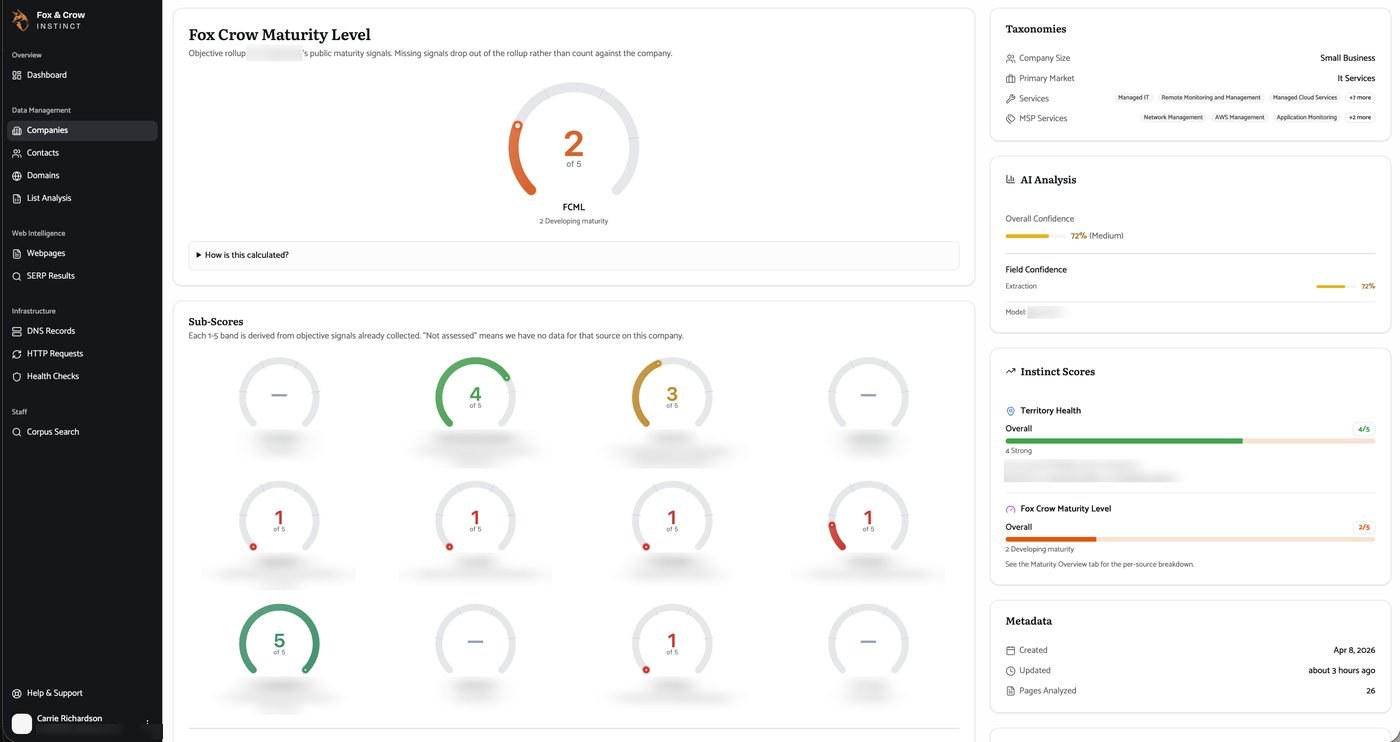
Open the score and see the parts.
The overall band is a roll-up of the underlying signals.
Each sub-score includes the supporting evidence and the date it was last checked.
If a score surprises you, open it and see what produced the result.
Size and maturity do not always move together.
A large MSP can score below a much smaller provider.
A company that grows almost entirely through referrals may have limited search visibility, little publishing activity and an old website. A smaller MSP investing heavily in those areas may score higher.
That difference matters when you are asking partners to market, recruit or support a new initiative.
Maturity does not measure the quality of IT delivery. It measures observable operating behavior.
Compare providers with the right peers.
A company can also be benchmarked against similar MSPs by region, size or services.
That gives your team context for the overall band and each underlying signal.
What teams use it to decide.
- Who gets called first. Start with providers showing stronger operating maturity.
- Who gets recruited. Compare potential partners before adding them to the program.
- Who gets MDF. Add current operating evidence to the allocation decision.
- Which partners need attention. A falling band gives the team a reason to investigate.
What the score does not measure.
The score does not assess a provider’s finances or security posture. Revenue does not determine the score.
It also does not decide whether a company is an MSP. Classification happens separately.
Start with 50 you already know.
Pick 50 MSPs your team knows well. We’ll score them with you and open the records that surprise you.
Twenty minutes. No pitch deck.